
A Complete Guide to Safe Driving as You Age
Home » A Complete Guide to Safe Driving as You Age
Many people focus on the dangers of young people driving. But driving while aging can also be dangerous. Many older adults begin to experience physical or mental impairments that affect their ability to drive and increase the chances of a car accident. This can put them and others on the road at risk.
Older adults can minimize their risks by recognizing how aging can affect driving ability. Learn to recognize the signs that you or a loved one can no longer safely operate a vehicle.
How Does Aging Affect Driving Ability?
The National Highway Traffic Safety Administration outlined several key ways that aging can affect driving ability. This can include physical and cognitive changes such as:
- Vision changes
- Delayed reaction time
- Hearing changes
- Reduced flexibility
- Change in cognitive ability
- Impairment in decision making
Of course, not all of these factors impact every senior. Be careful not to assume that someone can’t drive just because they are elderly. In fact, older drivers, as a group, actually have fewer accidents overall. Instead, learn to recognize the key health conditions that could affect the ability to safely operate a vehicle.

Common Health Conditions That Can Impact Driving
According to the LongROAD study conducted by the AAA Foundation for Traffic Safety (AAAFTS) from 2015 to 2025, there are several common health conditions that can affect an elderly person’s ability to drive. From vision changes and cognitive decline, mobility challenges, and prescription medication, there are several conditions to monitor when it comes to safely operating a vehicle.
Vision Changes
According to the LongROAD study conducted by the AAA Foundation for Traffic Safety (AAAFTS) from 2015 to 2025, there are several common health conditions that can affect an elderly person’s ability to drive. From vision changes and cognitive decline, mobility challenges, and prescription medication, there are several conditions to monitor when it comes to safely operating a vehicle.
Cognitive Changes
Normal aging can sometimes adversely affect the cognitive abilities important for driving safely. This can include having more difficulty remembering things, losing focus more often, processing things more slowly, and making decisions more slowly. Older adults may also take longer to react to unexpected situations or be less capable of making quick judgments in complex driving environments.
Conditions that affect the brain, such as dementia, stroke, or other neurological disorders, also have a very significant impact on cognitive driving abilities. These conditions could affect the ability to follow directions, recognize known hazards, understand various traffic situations, or respond safely and appropriately to changing road conditions.
Arthritis and Limited Mobility
Stiff joints, arthritis, muscle weakness, and reduced flexibility can happen naturally with age, but unfortunately, they often make the physical aspects of driving more difficult.
Limited mobility affects your ability to check blind spots, to move your foot quickly between the gas and brake pedals, or to comfortably control the steering wheel.
These physical changes affect a driver’s ability to respond quickly to road conditions and can make it harder to maintain full control of the vehicle at all times. However, limited mobility doesn’t have to mean that you stop driving altogether. If you have the right adaptive equipment and exercise caution behind the wheel, driving safely is still possible.
Medication Side Effects
Older adults routinely take medication to treat a variety of health conditions. Sometimes, these medications have side effects that impair a driver’s ability to operate a vehicle safely. This can include drowsiness, dizziness, and impaired vision. If you have prescription medications, a doctor or pharmacist can inform you of the side effects of different drugs that could make it difficult for you to drive.
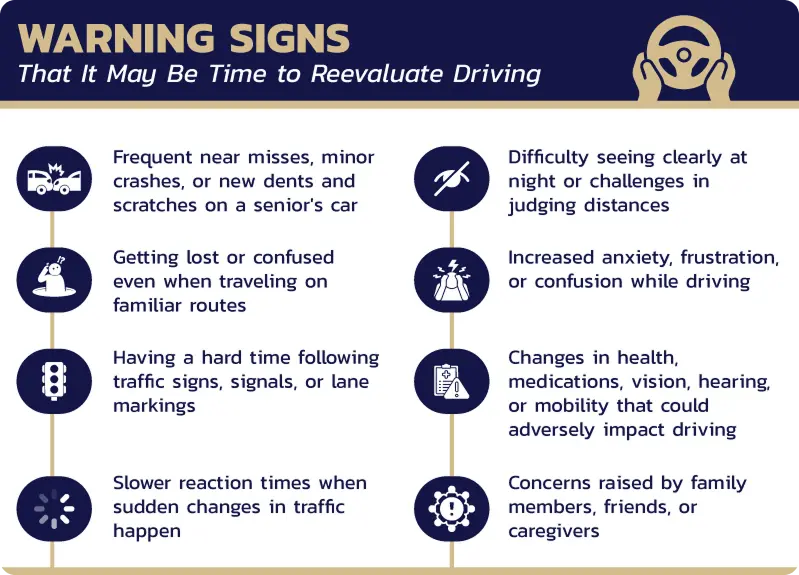
Warning Signs That It May Be Time to Reevaluate Driving
There are certain warning signs that can indicate it’s time to reevaluate driving ability. Some of these signs include:
Frequent near misses, minor crashes, or new dents and scratches on a senior’s car
Getting lost or confused even when traveling on familiar routes
Having a hard time following traffic signs, signals, or lane markings
Slower reaction times when sudden changes in traffic happen
Difficulty seeing clearly at night or challenges in judging distances
Increased anxiety, frustration, or confusion while driving
Changes in health, medications, vision, hearing, or mobility that could adversely impact driving
Concerns raised by family members, friends, or caregivers
These changes can take place slowly over time, so regularly monitoring an older loved one can keep everyone safe.
It’s important to identify these warning signs before an accident happens to try to keep everyone on the roads as safe as possible.
Tips for Staying Safe Behind the Wheel
The National Institute for Aging (NIH) suggests several tips for staying safe behind the wheel as you get older. These include:
- Getting regular vision exams to make sure you can still see clearly.
- Making adjustments to vehicles to make it easier to drive with conditions like arthritis.
- Planning safe routes that minimize stress and are familiar.
- Limiting nighttime driving in appropriate situations, especially if your vision is fading.
- Staying physically active to maintain health, mobility, and cognitive function.
If you do get into an accident, whether you’re involved in a typical car accident, a truck accident, or a motorcycle accident or any other incident, it’s also important to know what to do if an accident happens.
Tips For Having Difficult Conversations About Driving
It’s not easy to have a conversation with an elderly loved one about driving. However, there are some steps you can take that will make the conversation easier. These include:
- Keeping the conversation respectful: Caregivers and children should approach the conversation carefully with respect, understanding, and patience. And the focus should always be on safety, not criticism.
- Don’t stage an intervention: Keep the conversation between you and your elderly loved one. If the whole family gets involved in the discussion, your loved one is more likely to feel attacked and you risk alienating them.
- Use specific examples: Voice your concerns by using specific examples instead of making vague statements or accusations.
It is also important to involve older loved ones in the decision-making process. Plan for the future by discussing options such as limiting driving to certain times or locations, taking a driving assessment, using rideshare services, or exploring other transportation options.
Alternatives to Driving That Help Maintain Independence
Giving up driving doesn’t always have to mean giving up independence. Many transportation options are available to help older adults stay active, attend medical appointments, shop for essentials, and spend time with loved ones.
Ride-sharing services, taxis, public transportation, senior shuttle programs, volunteer driver services, and paratransit programs can all provide options for getting retirees to their destinations. Family members and neighbors may also sometimes be able to help with rides.
Planning ahead by combining errands, using grocery or prescription delivery services, and exploring local transportation resources can also make life easier by reducing the need to drive. Finding the right mix of different transportation options can help older adults to keep their freedom, remain socially connected, and continue participating in the communities they care about, even if they drive less or stop driving altogether.

The Importance of Regular Driving Evaluations
Driving evaluations can help determine whether an older adult can continue driving safely. These assessments are often recommended by doctors after a medical diagnosis. AAA offers several options for evaluating driving ability, including self-assessments, professional assessments, and clinical driving assessments.
Evaluations are often performed by occupational therapists who have specialized driver rehabilitation training. However, you can also seek out specialists to evaluate vision, reaction time, strength, flexibility, cognition, and conduct an on-road driving assessment.
The goal is not to use the evaluation as an excuse to take away someone’s license but to determine a person’s strengths while driving, recommend adaptive equipment or training if needed, and help drivers make informed decisions that protect both their safety and the safety of others.
How Communities Can Support Safe Aging Drivers and Prevent Senior Driver Accidents
Maintaining independence while staying safe on the road requires a collective, proactive approach. We can all help senior drivers stay safe and independent by supporting initiatives such as:
- Infrastructure and public transit: Safer road design, such as high-visibility street signs, dedicated turn lanes, and well-lit intersections, paired with reliable public transit options, gives seniors safe alternatives to driving when conditions are poor.
- Refresher and education programs: Specialized driver’s education courses help older adults adapt to age-related changes in vision, reaction time, and mobility, while also keeping them up to date on new traffic laws.
- Assistive vehicle technology: Advanced safety features, such as blind-spot monitoring, automatic emergency braking, lane-departure warnings, and emerging autonomous driving features, can compensate for slower reaction times and make vehicle operation significantly easier.
If an older driver does become in an accident, don’t let medical bills and insurance adjusters overwhelm you. Contact an experienced New Orleans car accident lawyer today. Our trial-ready team is available 24/7 to take the burden off your shoulders. Contact us online or call Scott Vicknair Injury Lawyers at 504-474-6158 today for your free case review, and remember, there are no fees unless we win.
FAQ’s
How often should older adults have their vision checked for driving?
According to the NIH, anyone over the age of 65 should have a comprehensive eye exam every year to ensure that they can see well enough to drive safely. Of course, older adults should also have their eyes checked right away if vision changes or other symptoms develop.
Can certain medications make it unsafe to drive?
Some medications make it unsafe to drive. If your medication causes drowsiness, fatigue, or other impairments, this could make driving unsafe.
What are the warning signs that an older adult may no longer be driving safely?
Near-miss accidents and confusion on familiar routes are among the many signs that an older adult may be unable to continue driving safely. Both older adults and their loved ones should watch for signs that driving is no longer safe.
Are there driving refresher courses for older adults?
There are several driving refresher courses designed specifically for older adults, often available in your local community. These programs can help participants update and refresh their knowledge of current traffic laws, learn safe driving techniques, and understand how age-related changes in vision, reaction time, and mobility can affect their driving.